Architects of intellectual capital



House of Lords Committee Report on AI, Copyright and the Creative Industries
Emerging issues in generative AI and rights of creators in copyright law.
COPYRIGHTARTIFICIAL INTELLIGENCE
Elizabeth Oyange
3/6/20262 min read
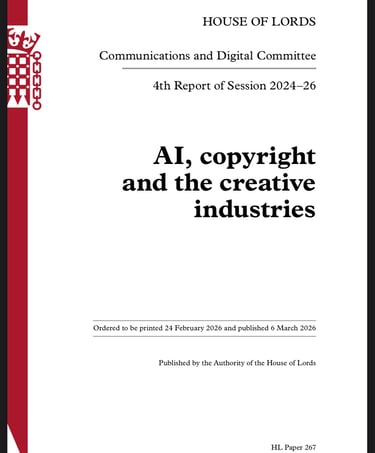
Just today, after a series of stakeholder engagements, the House of Lords has published a report on AI, Copyright and Creativity.
The report addresses the critical challenge of generative AI systems which can now produce convincing imitations of creative material in seconds, often trained on vast quantities of human-created content without explicit consent or compensation. This development threatens the protections afforded to creators under existing copyright law, prompting urgent recommendations for government action.
The Committee's analysis reveals that the problem is not that the UK's copyright framework is outdated or fundamentally flawed. Rather, the existing legal structure proves insufficient because of two critical gaps.
First, there is limited transparency from AI developers regarding how their models have been trained and which works were used in the training process. This opacity prevents rightsholders from determining whether their content has been incorporated and from taking appropriate enforcement action.
Second, the UK lacks robust "personality rights" or specific legal protections for digital likeness, leaving creators and performers vulnerable to harmful outputs that imitate their distinctive style, voice, or persona without authorization.
The recommendations include rejecting weakened copyright exceptions by calling on the government to rule out introducing a new commercial text and data mining (TDM) exception, and that the government introduces new legal protections that give creators and performers clear control over commercial exploitation of their identity, voice, and distinctive style.
They also call for transparency about AI training data to become a statutory obligation rather than a voluntary practice, ensuring that UK AI developers disclose information about their training datasets.
Finally, they call for supporting a fair and inclusive licensing market which backs the creation and adoption of technical tools that enable a "licensing-first" approach, which will include open, globally aligned standards for rights reservation, data provenance tracking, and the labelling of AI-generated content.
Rather than weakening copyright protections to attract AI companies, they call for the government to strengthen the legal and technical framework that enables creators and AI developers to work together transparently and fairly.
This makes for a very interesting read for copyright enthusiasts.
#AI #Copyright #CreativeIndustries #HouseOfLords #IP #Innovation
IPQUAIL
Kenya's leading boutique intellectual property law consultancy. Protecting trademarks, patents, copyright, and innovations across East Africa.
COMPANY
Contact us
info@ip-quail.com
+254 743549257
© 2026. All rights reserved.
Architects of intellectual capital
SERVICES
LEGAL
Trademark Registration
Patent Drafting and filing
Copyright Protection
Data Protection
IP Commercialization
IP Audit
IP Valuation
IP Management and strategy